The jeep
Earth AbidesThe jeep is a salvaged vehicle that Ish and the boys restore for an expedition beyond the Tribe’s home territory. More than a means of transport, it turns the remnants of the old road system into a route between isolated communities: its progress depends on improvised repair, its mechanical limits repeatedly interrupt plans, and its return brings news of people living by different customs. Its passage from forgotten display-room relic to working expedition vehicle makes material survival inseparable from inherited knowledge and collective labor.
Finding and Choosing the Jeep
Ish’s search begins at a former station, where he consults a telephone directory hanging beside a long-dead telephone. The pages are so brittle that fragments break away when he opens the book, but he finds the address of the former local jeep agency. With the roads deteriorating, he reasons that a jeep would be more useful than an ordinary car. An address preserved in a failing book thus becomes the first step toward recovering a machine suited to the transformed landscape.
At the agency, the boys find a jeep behind a dirty display window. The vehicle is coated in dust and has four flat tires, yet the red paint beneath the dust remains shiny. Its speedometer records only nine miles. Ish rejects it as too new, preferring a vehicle that has already been broken in and might therefore be easier to put back into use. The distinction is practical rather than sentimental: the most pristine survivor is not necessarily the most serviceable one.
The search continues into the garage behind the display-room, where the other vehicles also have unusable tires. One jeep has its hood open and parts scattered around, apparently left during a repair, so Ish passes it by. When the boys try to enter the chosen vehicle, they find the door locked. Ish tells them to use the hammer, but when they do not break the lock effectively, he swings the hammer himself and knocks the door inward. The episode places the old tool and the old vehicle in the same work of recovery: access to the machine requires force, but making it run will require a different kind of knowledge.
Repair, Starting, and First Drive
The jeep’s fuel tank is empty, as are most of the tanks they encounter. Ish does not know whether the gasoline has escaped through an imperfect cap or seeped through the carburetor. They find fuel in a drum and pour five gallons into the tank. Ish fits fresh spark-plugs, primes the carburetor, sets the choke, switches on the ignition, and presses the starter. The engine first grunts, then turns faster, and finally roars into life.
The start gives Ish a sense of pride not just in the immediate repair but in the engineering and workmanship embodied by the engine. It has survived more than twenty years of idleness and can still operate. Yet the first success is incomplete: the engine dies when the fuel remaining in the carburetor runs out. They prime it again several times before the old pump draws gasoline up from the tank and the engine runs continuously. The working machine is not restored all at once; it is brought back through repeated attempts, with each apparent success exposing another dependency.
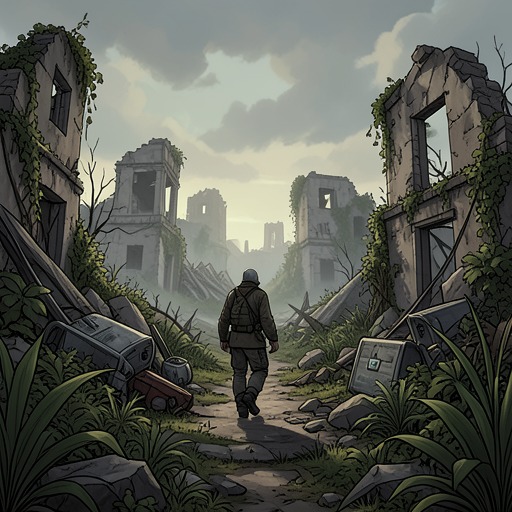
Tires become the most persistent problem. The jeep can be made to run, but its tires are flat, and the roadways are obstructed by the debris of fallen buildings, where leaves, dust, and winter rain have reshaped the rubble into banks and hillocks. Ish steers around the street obstructions, but a brick gives the left rear tire a sudden blowout. He drives the jeep home slowly on the flat, bumping over the damaged streets and reaching the final grade just ahead of the dog-teams. Though the trip ends with a mechanical failure, Ish considers it a success because he has brought the vehicle home.
At the house, Ish presses the horn. After years of silence it sounds again, but the response is not the gathering of people he expects: dogs bark from all directions, and the team-dogs and boys join the noise. The horn can still summon a chorus, but the social world that once would have answered it has disappeared. The jeep’s first arrival therefore offers both triumph and a measure of the changed community around it.
Preparing the Expedition
The boys and Ish continue driving the jeep every day. Rather than treating each blowout as an isolated mishap, they use the repeated failures to identify tires that seem capable of lasting through some wear. This trial-and-error process makes reliability something they establish gradually, not a quality they can assume from the vehicle’s appearance or former function.
On the fourth day, the boys set out with an extra battery, spare tires, and other equipment packed into the back. They are intensely excited; their mothers are close to tears at the prospect of such a long separation. Ish himself wants to accompany them and is nervous about not going. The jeep makes the journey possible, but the departure also exposes the human stakes of its use: the expedition is a step beyond the community’s boundaries, and the supplies and repaired tires answer only some of the uncertainty involved.
The Journey and Its Significance
When the boys return, Ish recognizes their approach by the jeep’s horn while teaching Joey with coins and bills. He and Em, the children, and the dogs rush out to meet it. The vehicle is dirty, battered, and visibly travel-worn, but it has made the journey. Its altered condition records the strain of use, while its return confirms that it has carried the boys through terrain and encounters beyond the Tribe’s immediate experience.
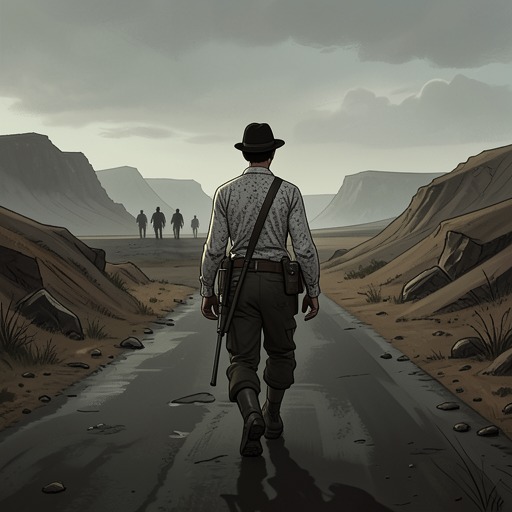
The boys report that the highway to Los Angeles has only a few minor washouts and landslides, which the jeep can negotiate in four-wheel drive. From Los Angeles they take U.S. Route 66 east across a mostly open desert, where occasional blown sand and tire blowouts cause trouble. The bridge over the Colorado River is shaky but passable. These details show how the jeep’s usefulness depends on both its mechanical capacity and the uneven survival of infrastructure: it can handle damaged roads and desert travel, but not without limitations or risk.
The vehicle also brings the Tribe knowledge of communities it could not otherwise easily reach. Near Los Angeles, the boys encounter religious fanatics who call themselves the People of God. Farther east, they find a small community near an old pueblo outside Albuquerque, where people grow corn and beans, keep horses, and are suspicious of strangers. The jeep does not erase the distance between these societies or make them alike. It carries the boys far enough to discover that survivors have developed different ways of life, and it carries their account back to Ish and the Tribe.
The jeep’s significance lies in this double function: it is an object that has to be coaxed back into motion and a working link between otherwise isolated human groups. Its engine can start after decades of neglect, but only after fuel, spark-plugs, repeated priming, and a functioning pump come together; its journey succeeds, but flat tires, blowouts, damaged roads, and a shaky bridge remain part of the story. The machine preserves a fragment of the old technological world without restoring that world. What it enables instead is a limited, hard-won form of connection, sustained by repair and by the people willing to travel.